Orange Pi 4A: New $35 AI-Powered Board Challenges Raspberry Pi
Shenzhen, Tuesday, 19 November 2024.
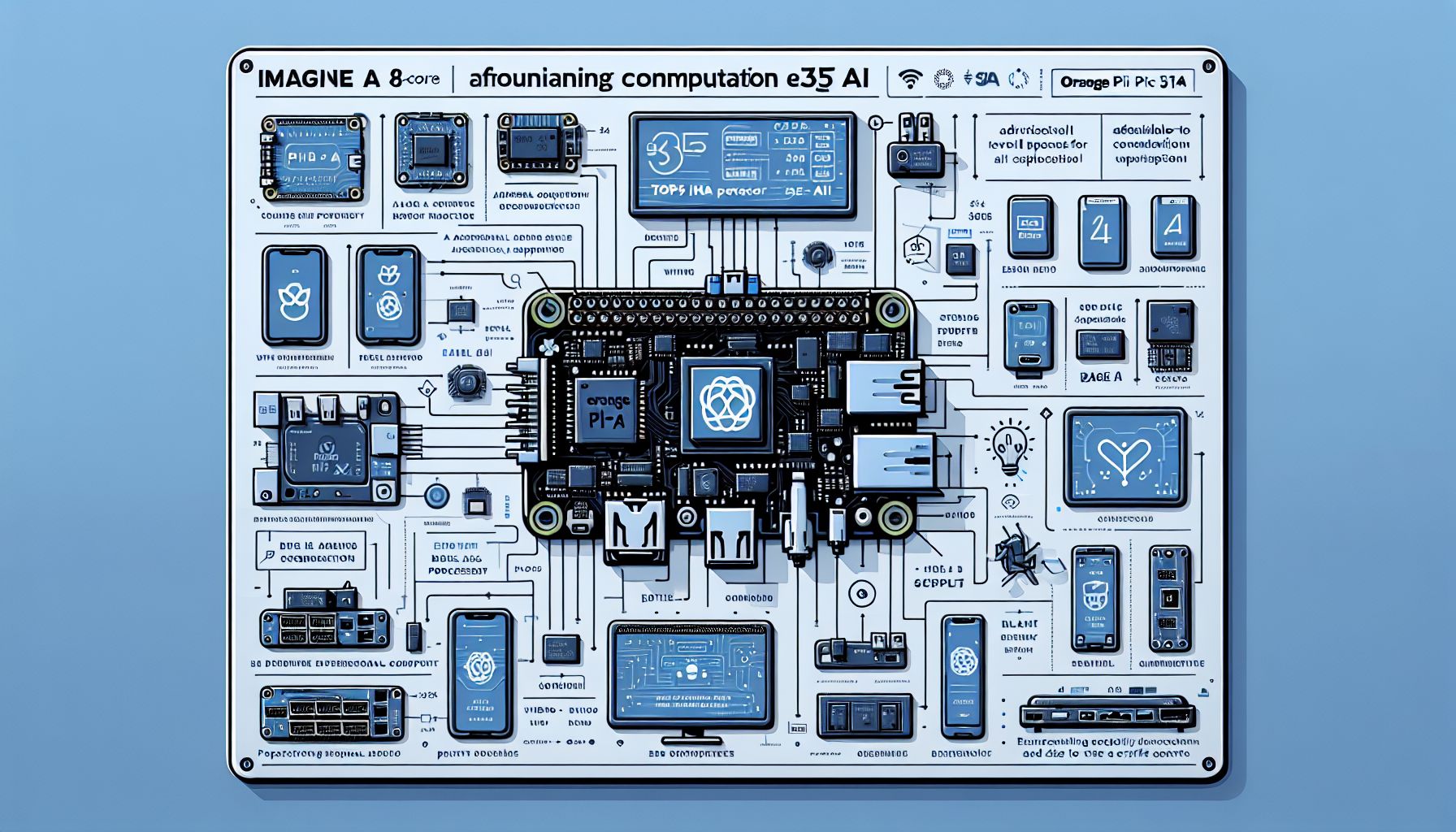
Orange Pi launches a groundbreaking single-board computer featuring an 8-core processor and dedicated AI capabilities at just $35. The Orange Pi 4A integrates a powerful 2 TOPS neural processor for edge AI applications, making advanced computing accessible to developers and hobbyists. With support for 4K video, multiple display outputs, and extensive connectivity options, this credit card-sized powerhouse brings professional-grade features to the maker community at an affordable price point.
Features and Specifications
The Orange Pi 4A is a single-board computer that offers an impressive array of features packed into its compact form. At its core is the Allwinner T527 processor, which combines eight Arm Cortex-A55 cores with a RISC-V core, providing robust processing power for a wide range of applications. The board also includes a Mali-G57 MC1 graphics processor and a dedicated neural processing unit (NPU) capable of achieving 2 tera-operations per second (TOPS), making it highly suitable for edge AI tasks[1].
Performance and Connectivity
With clock speeds reaching up to 1.8 GHz for high-performance cores and 1.42 GHz for high-efficiency cores, the Orange Pi 4A is built for speed and efficiency. It supports H.264/H.265 video decoding at up to 4K at 60 frames per second and H.264 encoding at up to 4K at 25 frames per second, ensuring smooth media playback and recording capabilities[2][3]. Connectivity options are plentiful, including four USB Type-A ports, a gigabit Ethernet port, HDMI 2.0, MIPI DSI, and embedded DisplayPort 1.3. The addition of Wi-Fi 5 and Bluetooth 5.0 further enhances its connectivity potential, making it a versatile choice for various networking setups[2].
Comparative Analysis
When compared to its well-known competitor, the Raspberry Pi, the Orange Pi 4A offers several advantages, particularly in terms of processing power and AI capabilities. While both boards share a similar form factor and GPIO layout, the Orange Pi 4A’s integration of a RISC-V core and a powerful NPU sets it apart for developers focusing on AI applications. Its ability to handle multiple display outputs and support for extensive I/O options further broadens its appeal for users looking for a more feature-rich alternative at a competitive price point[3].
Use Cases and Recommendations
The Orange Pi 4A is ideal for a variety of applications, ranging from intelligent industrial controls and commercial displays to retail payment systems and robotics. Its AI capabilities make it particularly appealing for projects involving machine learning and computer vision. Developers working on projects that require high-resolution video outputs or multiple interfaces will find this board highly beneficial. Given its affordability, it also serves as an excellent educational tool for students and hobbyists interested in exploring AI and edge computing technologies[4].
Conclusion
Overall, the Orange Pi 4A represents a significant step forward in the realm of single-board computers, offering an impressive balance of power, features, and affordability. Its introduction to the market not only challenges existing leaders like the Raspberry Pi but also expands the possibilities for developers and enthusiasts looking to leverage AI in their projects. As the documentation continues to evolve, and with planned support for mainline Linux, the Orange Pi 4A is poised to become a staple in the maker community[2].