IBM's AI Revolution: From Turkey Bones to Breakthrough Medical Tech
Yorktown Heights, Wednesday, 27 November 2024.
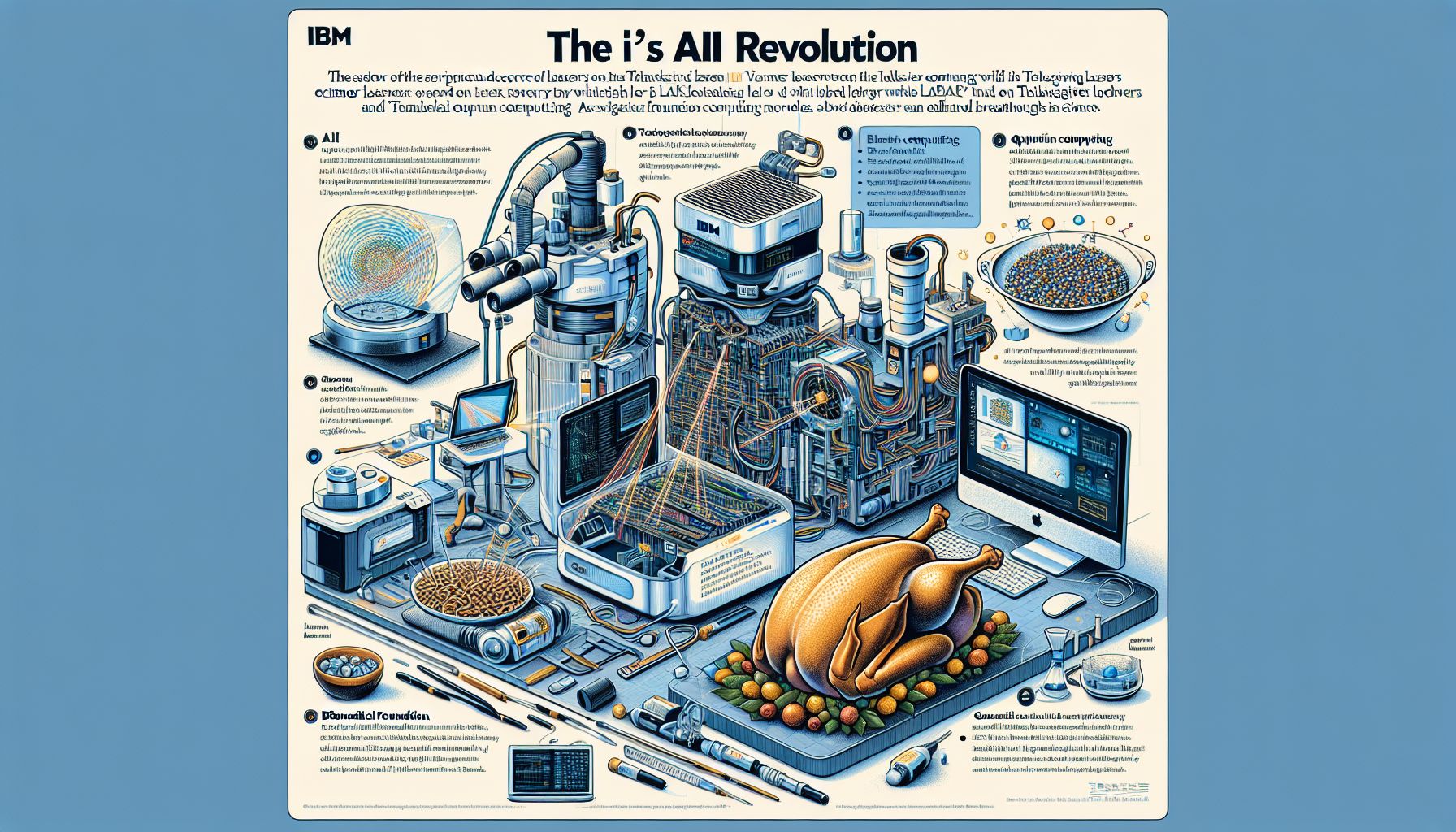
In a remarkable display of serendipitous innovation, IBM researchers’ experiments with excimer lasers on Thanksgiving turkey leftovers in the 1980s led to the development of LASIK eye surgery. Today, IBM continues this tradition of unexpected discoveries with their latest AI tools and quantum computing breakthroughs, demonstrating how unconventional approaches can revolutionize multiple scientific fields. Their new Granite platform and biomedical foundation models are accelerating scientific discovery, while maintaining IBM’s legacy of transforming seemingly simple experiments into groundbreaking technological advances.
Pioneering AI Tools and Platforms
IBM’s recent unveiling of AI tools and platforms, such as the Granite Experiments, represents a leap forward in AI model development. This platform allows developers to test ideas and accelerate updates in AI models, a process that traditionally takes around a year. By offering open-source experimental features, IBM is not only enhancing AI’s capabilities but is also democratizing access to powerful tools that can potentially solve complex scientific problems more efficiently[1][2].
Biomedical Breakthroughs with Open-Source Models
In a move that could transform drug discovery, IBM has open-sourced advanced biomedical models, offering the scientific community powerful tools to accelerate research. These models, which integrate multiple modalities such as sequences, graphs, and images, address gaps in existing models by aggregating information across domains. This advancement is expected to streamline traditional drug development processes, significantly reducing the time and cost involved in bringing new therapies to market[3].
Quantum Computing: A New Era of Scientific Discovery
IBM’s advancements in quantum computing, showcased at the inaugural IBM Quantum Developer Conference, highlight the potential of quantum technology to solve problems once deemed unsolvable. The IBM Quantum Heron processor, capable of performing up to 5,000 two-qubit gate operations, exemplifies the strides made in quantum hardware. This capability not only enhances the execution of complex algorithms but also advances IBM’s goal of achieving quantum advantage—where quantum systems outperform classical computers for specific tasks[4][5].
Implications for the Future
The implications of IBM’s innovations are far-reaching. By integrating AI and quantum computing, IBM is poised to address some of the most pressing global challenges, such as climate change and healthcare. These technologies enable the exploration of novel scientific problems, offering solutions that were previously beyond reach. As IBM continues to redefine the boundaries of technology, the potential for groundbreaking discoveries across various fields remains vast and promising[6][7].