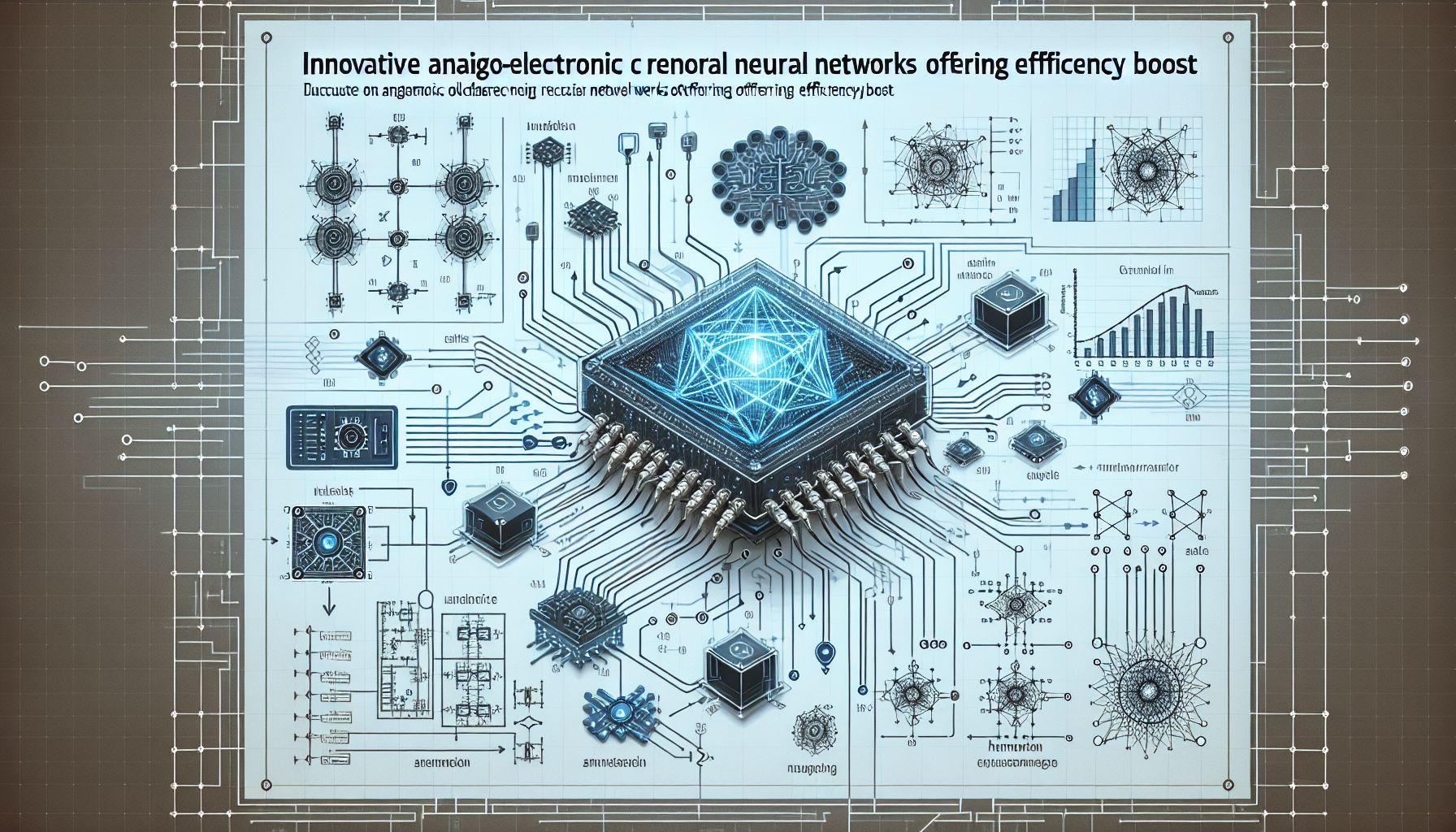
Innovative Analog-Electronic Neural Networks Offer Efficiency Boost
Paris, Friday, 5 September 2025.
Recent research highlights a novel analog-electronic implementation of harmonic oscillator recurrent neural networks, showcasing enhanced parameter efficiency and learning speed over traditional architectures.
Advancements in Analog-Electronic Implementations
A recent study available on arXiv has introduced a groundbreaking analog-electronic implementation of harmonic oscillator recurrent neural networks (HORNs). These oscillatory models are shown to offer significant advantages in terms of parameter efficiency, learning speed, and robustness compared to traditional non-oscillating architectures. The research focused on the feasibility of implementing HORNs in analog-electronic hardware, aiming to maintain the computational performance of their digital counterparts [1].
Methodology and Implementation of HORNs
The researchers employed a digital twin approach, successfully training a four-node HORN in silico for sequential MNIST classification. The trained parameters were subsequently transferred to an analog electronic implementation. Custom error metrics indicated that the analog system could successfully replicate the dynamics of the digital model in most test cases. However, only a 28.39% agreement was observed when using the digital model’s readout layer on data generated by the analog system, due to precision differences between the analog hardware and the digital model’s floating-point representation [1].
Challenges and Solutions in Analog Systems
The discrepancy in precision between the analog and digital implementations primarily stems from the analog hardware’s limitations. Despite this, when the analog system was used as a reservoir with a re-trained linear readout, its classification performance matched that of the digital twin, preserving the information content within the analog dynamics. This result underscores the potential of analog systems to achieve energy-efficient computation while effectively implementing oscillatory neural networks [1].
Implications for Future Technology
This study’s proof-of-concept demonstrates that analog electronic circuits can effectively implement oscillatory neural networks for computational tasks. Such advancements pave the way for the development of energy-efficient analog systems that exploit brain-inspired transient dynamics, offering promising applications in various fields, including artificial intelligence and machine learning [1].