Edge AI Hardware Market Set to Double by 2029, Reaching $54.7 Billion
Woburn, Thursday, 21 November 2024.
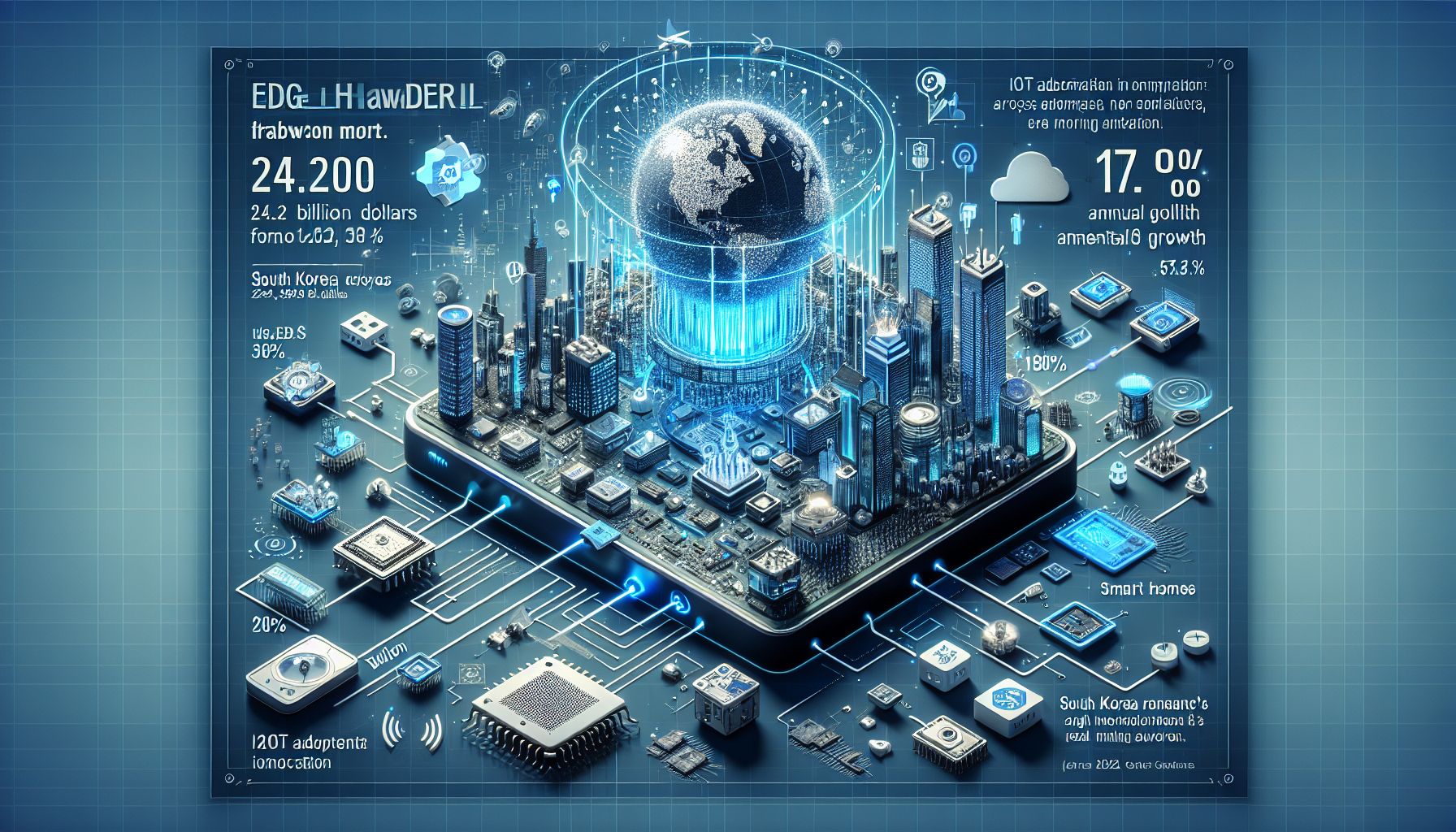
The edge AI hardware sector is experiencing explosive growth, projected to surge from $24.2 billion in 2024 to $54.7 billion by 2029. This remarkable 17.7% annual growth is driven by increasing IoT adoption across healthcare, smart homes, and industrial automation. South Korea’s planned $6.94 billion AI investment by 2027 highlights the Asia-Pacific region’s dominant role in this transformation.
Driving Forces Behind Edge AI Expansion
The rapid growth of the edge AI hardware market is fueled by a variety of factors, with the proliferation of IoT devices at the forefront. These devices, found in applications ranging from smart home technologies to industrial automation systems, are transforming how data is processed and utilized. Edge AI allows for real-time decision-making and reduces the dependency on centralized cloud computing, providing significant advantages in speed and efficiency[1].
Technological Advancements and Challenges
As edge AI hardware becomes increasingly critical, the industry is seeing significant technological advancements. For instance, generative AI is playing a pivotal role in optimizing hardware for specific computational tasks, which improves efficiency and reduces power consumption. However, the complexity of building robust edge networks and ensuring device interoperability remains a challenge[2]. Companies are actively seeking solutions to these integration issues to fully harness the potential of edge AI.
Asia-Pacific: A Leader in Edge AI
The Asia-Pacific region, particularly countries like South Korea, China, and Japan, is at the forefront of edge AI hardware development. South Korea’s substantial investment of USD 6.94 billion in AI by 2027 exemplifies the region’s commitment to advancing AI infrastructure[1]. This investment is expected to boost semiconductor research and development, positioning the Asia-Pacific as a dominant force in the global edge AI market.
Implications for the Industry
The implications of this rapid growth in edge AI are profound. As more industries integrate AI-driven technologies, there is a need for new business models and strategies to capitalize on these advancements. The ability to process data locally at the edge, rather than relying on cloud connectivity, is transforming industries like healthcare and automotive, where real-time data processing is crucial[2]. The ongoing development of edge AI hardware is expected to lead to more compact and energy-efficient solutions, further expanding its application across various sectors.