ZeroPoint Technologies Transforms Data Centers with New Memory Compression
Göteborg, Thursday, 20 February 2025.
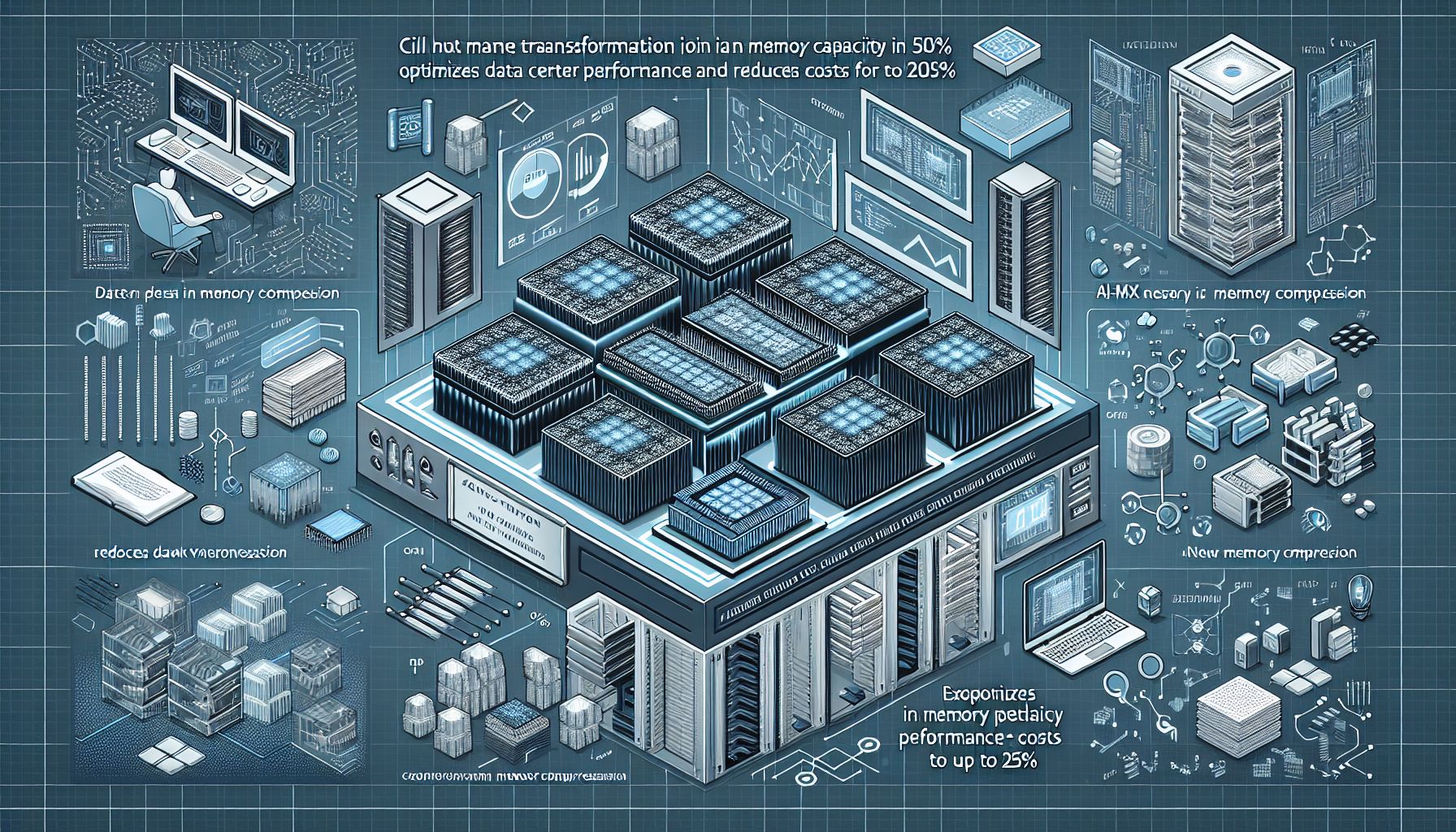
ZeroPoint Technologies introduces AI-MX, enhancing memory capacity by 50%, optimizing data center performance and reducing costs by up to 25%.
Revolutionary Memory Optimization Technology
ZeroPoint Technologies AB has unveiled AI-MX, a groundbreaking hardware-accelerated memory optimization solution that promises to transform data center operations [1]. The technology enables nearly instantaneous compression and decompression of deployed foundational models, delivering a remarkable 1.5 times increase in addressable memory, memory bandwidth, and tokens served per second [1][4]. Operating with nanosecond-level latencies, the solution exceeds traditional algorithms by over 1000 times in speed [4].
Technical Specifications and Performance
The innovative solution demonstrates impressive technical capabilities, allowing 150GB of model data to fit within 100GB of High Bandwidth Memory (HBM) capacity [1]. In practical terms, AI accelerators equipped with 4 HBM stacks and AI-MX can operate as if they have the capacity of 6 HBM stacks [1]. The technology has been proven on a TSMC 5nm node [1], and delivers up to 50% more performance per watt while increasing general memory capacity by 2-4 times [1].
Market Impact and Future Deployment
The timing of AI-MX’s release is significant, as enterprise and hyperscale datacenters face increasing demands for memory capacity, power, and bandwidth [1]. According to market analysis, the AI software and tools market is projected to reach $440B by 2029 [1]. The solution is scheduled for delivery to initial customers and partners in the second half of 2025 [1], positioning ZeroPoint Technologies to address critical challenges in this rapidly expanding market [1].
Cost Benefits and Industry Integration
The technology’s implementation is expected to generate substantial cost savings for companies operating large-scale datacenters for AI applications [1]. When combined with modern technologies like CXL 3.1, which was introduced with enhanced fabric connectivity and memory RAS features [2], the solution creates a new memory tier that effectively balances performance and cost. This integration is particularly significant as it addresses the growing challenge of stranded memory in data centers [2].