Magnon Transistor Breakthrough Promises Energy-Efficient Computing
New York, Wednesday, 30 October 2024.
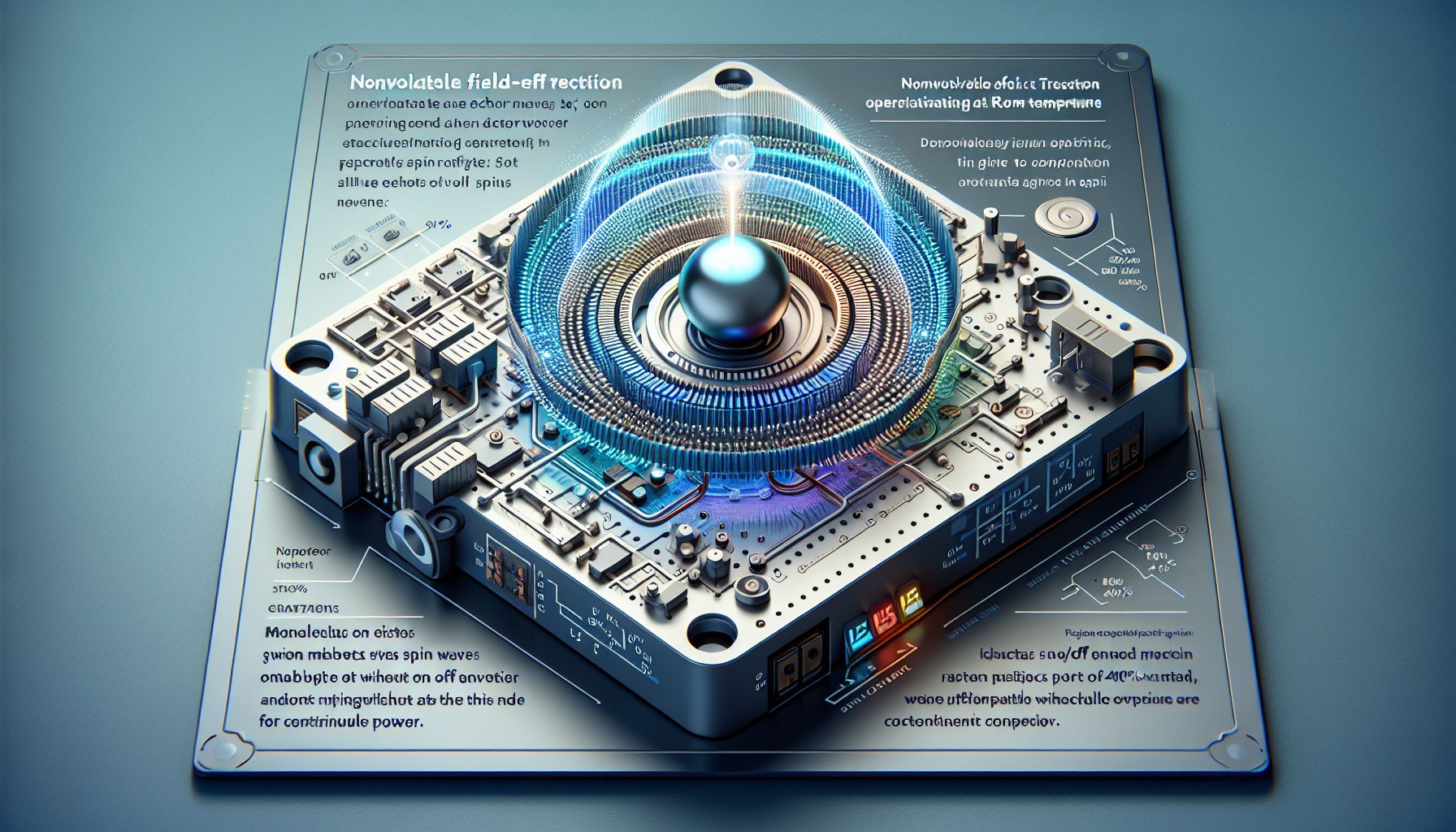
Scientists have developed a nonvolatile magnon field effect transistor operating at room temperature, marking a significant advance in energy-efficient electronics. This device, which controls spin waves without electron movement, achieves a high on/off ratio of 400% and operates without constant power input. The innovation could revolutionize computing by dramatically reducing heat generation in integrated circuits.
Understanding Magnon Technology
Magnons, the collective excitations of magnetic moments, have emerged as a promising solution to the energy and heat challenges faced by modern electronics. Unlike traditional electronic devices that rely on electron movement, magnons convey spin information, potentially eliminating Joule heating, a significant source of energy consumption in integrated circuits. The development of a nonvolatile magnon field effect transistor (FET) marks a pivotal shift towards energy-efficient computing, especially as the industry seeks alternatives in the post-Moore era[1].
The Design and Functionality of the Magnon FET
The innovative magnon FET design involves a ferrimagnetic insulator, Y3Fe5O12, layered on ferroelectric materials like Pb(Mg1/3Nb2/3)0.7Ti0.3O3 or Pb(Zr0.52Ti0.48)O3. The device utilizes three platinum stripes serving as the injector, gate, and detector. This configuration allows for the regulation of magnon transport through electric field gating, achieving an impressive on/off ratio of approximately 400% at room temperature. The use of electric fields to control magnon currents overcomes the inherent challenge of managing spin information without electron movement, a feat that has long eluded researchers[2].
Implications for the Future of Electronics
The implications of this breakthrough are profound. By mitigating the heat issues associated with increased transistor density, magnon FETs promise to extend the viability of integrated circuits, aligning with the industry’s pursuit of sustainable processing solutions. Furthermore, this technology could pave the way for advancements in unconventional computing, including neuromorphic computing, where energy efficiency is paramount. As Professor Haifeng Ding noted, “Our finding establishes a fully functional nonvolatile magnon FET at room temperature,” highlighting the potential for these devices to redefine computing paradigms[3].
Challenges and Future Directions
Despite these advancements, several challenges remain. The weak coupling between electric fields and magnetic moments poses a hurdle in controlling magnon currents. Researchers are exploring methods to optimize this interaction, potentially through material innovations or novel device architectures. Future studies may focus on the magnon diffusion length and the effects of gating, utilizing advanced techniques like Brillouin light scattering. As the field evolves, the integration of magnonics with existing semiconductor technologies could herald a new era of high-performance, low-power electronics[4].