Chroma Unveils New High-Power DC Electronic Loads for Testing
Taoyuan, Monday, 10 February 2025.
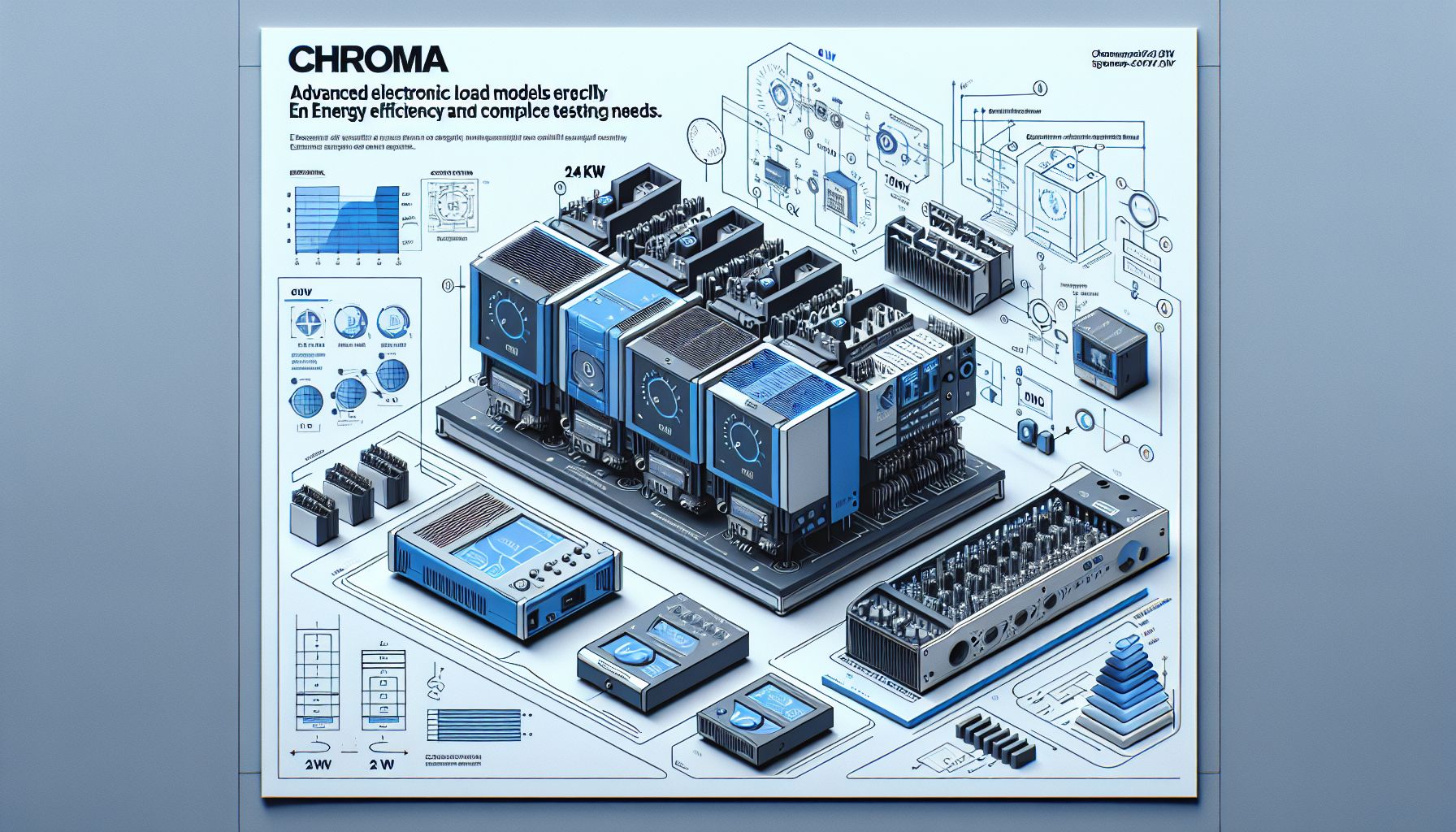
Chroma introduces advanced electronic load models, ranging from 2 kW to 240 kW, tailored to meet European energy efficiency and compliance testing needs.
Advanced Technical Specifications
The newly launched electronic load series offers impressive versatility with voltage ranges spanning from 0-150V to 0-600V [1]. A standout feature is the ability to achieve up to 240kW through parallel configuration, while individual units are available in power ratings from 2kW to 24kW [1][3]. The systems incorporate advanced measurement capabilities, with voltage accuracy reaching 0.015%+0.015% F.S. and current measurement precision at 0.04%+0.04% F.S. [2].
Market Impact and Applications
This launch comes at a crucial time for the DC electronic loads market, which is projected to grow at a CAGR of 14.7% from 2025 to 2032 [7]. The new models are particularly significant for testing power modules, automotive batteries, and fuel cells [2]. With the integration of User Defined Waveform (UDW) capabilities and Sync Dynamic Control [1], these loads are positioned to meet the increasing demands of the European power electronics testing market.
Compliance and Safety Features
The new series demonstrates Chroma’s commitment to European standards with both CE Mark certification and RoHS 2 compliance [1][3]. The systems include comprehensive protection features such as overcurrent, overpower, and over-temperature safeguards, along with overvoltage and polarity reverse alarms [2]. These safety measures are crucial for ensuring reliable testing operations in advanced power electronics applications.
Testing Capabilities and Flexibility
Each model offers multiple operating modes including constant voltage, current, resistance, and power [2], providing the versatility needed for comprehensive power module testing. The systems feature a 300% peak overpower capability [2], making them particularly suitable for simulating fault conditions in automotive and renewable energy applications. For situations requiring higher power capacity, the units can be operated in parallel to achieve increased load current [2].